
PRF Therapy for Chronic Pain Platelet-Rich Fibrin with Albumin Gel
Your body already knows how to heal itself. We just give it the signal it needs to get started.
Dr. Nguyen explains why steroids block healing, and how your own blood can permanently resolve pain. Watch before your first appointment.
Can Chronic Pain Be Healed Naturally Without Steroids?
The answer is yes, and the solution has been inside your body the whole time.
I’m Dr. Thanh Nguyen, Board-Certified in Internal Medicine, practicing in Phoenix and Mesa, Arizona.
Over the past several years, my clinic has developed and refined a treatment approach that has resolved chronic pain in more than 90% of our patients after just one, two, or three injections.
No steroid medications. No surgery. No chemicals from outside your body.
We do it by using the platelets in your own blood to send a signal to your immune system, the same signal your body uses to heal a cut, a broken bone, or a surgical wound. We have just figured out how to aim that signal at the exact source of your pain.
Kind of simple, right?
The science behind it took years to develop. But the core idea is straightforward: your body knows how to heal. We help it recognize where to go.
Our Philosophy on Pain
Three Principles That Changed Everything
Most clinics approach chronic pain by trying to reduce inflammation.
We approach it by doing the opposite, and that difference is why our results look so different from what most patients have experienced elsewhere.
Here are the three principles behind everything we do.
Principle 1: Every part of your body has the ability to heal itself within three months.
Think about what your immune system already does without any help from a doctor.
A cut in the skin heals in a few weeks. A broken bone heals in one to two months.
Major abdominal or heart surgery, where dozens of tissues are cut, heals within two to three months.
If your immune system can heal all of that, it has everything it needs to heal your pain. The capability is already there.
Principle 2: Pain that lasts longer than three months is a failure of the immune response, not a failure of your body.
When pain goes on for months or years, it does not mean healing is impossible. It means the immune system has not recognized the injury and responded to it properly. The healing process got stuck.
Just like cancer is understood to be a failure of the immune system to recognize abnormal cells, chronic pain is a failure of the immune system to recognize an unresolved injury site.
The solution is not to block the immune system with steroids or anti-inflammatory drugs. The solution is to provoke it to “unstick” the healing process and get it moving again.
Principle 3: The source of pain is almost always a single pinpoint location, not a broad area.
This is the part that took me over 1,000 injections across three years to fully understand.
I had to rethink everything I was doing before I figured this out, and I genuinely wish I had discovered it sooner for the patients I treated in those early years.
The source of pain is typically smaller than one centimeter in diameter. If you inject even a few centimeters away from that exact spot, the treatment will not work well.
This is why so many patients get injections elsewhere and feel temporary relief but never full resolution; the right substance is being used in the wrong location.
My mentor used to say: “Pain never lies, but the image might lie. Treat the patient, don’t treat the image.” That principle guides everything we do.
Why Steroids Are the Wrong Tool for Chronic Pain
The most common injection in pain medicine today is a cortisone or steroid epidural. We understand why it reduces inflammation and temporarily reduces pain. But here is the problem: steroids work by telling your immune system to go away. And if your immune system goes away, nothing is left behind to fix the original injury.
The pain comes back. Every time.
Anti-inflammatory medications like ibuprofen, naproxen, and aspirin work the same way; they block the immune response that would otherwise be doing the healing. You get short-term relief and long-term non-healing.
Radio Frequency Ablation (RFA), where a probe is heated to burn off the pain-sensing nerves, can also reduce pain, but the nerves grow back within a year and the pain returns. The injury was never addressed.
At The Accident Doctors, we do not use steroids for injection. We do the opposite. We intentionally create a small, temporary increase in inflammation at the exact source of pain because that is what tells your immune system to come and fix it.
The goal is not temporary relief. The goal is permanent resolution.
Where Most Clinics Inject and Why It Often Does Not Work
Most spine pain in the neck and lower back is blamed on herniated discs shown on MRI scans. The standard treatment is a steroid epidural injection into the space around the spinal cord, targeting that herniated disc.
We believe this approach is wrong in most cases, and here is why.
If a herniated disc was truly compressing a nerve enough to cause pain, you would almost always see all three of the following at the same time: pain, numbness, and weakness. Those three nerve functions travel together in the spine and are almost never separated.
If you have pure neck or back pain with no numbness and no weakness in your arms or legs, the actual source of your pain is almost certainly not the disc inside the spinal column. It is the facet joint, the pivot point on the outside of the spine, where the vertebrae connect and move.
You can push directly on a facet joint with your fingers and produce the exact pain the patient is describing. You cannot push on a herniated disc because the bone is in the way.
We inject on the outside, where the real source of pain is. That is what makes the difference.
The 3rd Generation PRF with Albumin Gel
What It Is and How It Works
When you get a cut or a bruise, platelets are the first responders.
They stop the bleeding. More importantly, they send out a distress signal that tells your immune system: something is damaged here, come and fix it. That signal is what starts the entire healing process.
We harness that exact mechanism to treat chronic pain. We draw your blood through a standard blood draw, separate the platelets, and re-inject them at the precise source of your pain, all within the same appointment, usually within an hour.
The platelets are completely natural, from your own body, with no chemical additives and no risk of allergic reaction. You cannot be allergic to your own blood.
What makes our protocol different from most clinics is the generation of platelet technology we use.
Most clinics use 1st generation PRP (Platelet Rich Plasma), which was developed in the 1980s and contains an anticoagulant that prevents the platelets from clotting in place. The platelet signal lasts only one to three days.
We use a 3rd-generation PRF with Albumin Gel, first published in 2020 and further refined at our clinic beginning in 2023. The albumin gel is created by heating the protein-rich serum from your own blood. When heated, albumin protein expands into a fluffy gel that traps platelets inside.
This creates an extended-release effect: the platelet signal remains active for 14 days rather than 3. Fourteen days of immune system activation at the exact source of your pain drive permanent resolution.
Since the beginning of 2023, we have treated over 600 patients using this protocol. More than 90% have experienced complete pain resolution after one, two, or three injections.
What to Expect After a PRF Injection
Knowing what is coming after an injection takes the anxiety out of the process. Here is what most patients experience:
Days 1 to 2: Injection site soreness, similar to what you feel after a flu shot. This is normal and expected.
Days 3 to 4: A temporary rise in pain at the treated area. This is not a setback; it is your immune system arriving at the site and beginning work. We interpret this as a positive sign.
Week 2 to 3: Most patients report the beginning of real healing during this window. Pain decreases significantly, sometimes completely.
After week 4: If pain has not fully resolved, a repeat injection is performed. Most neck and lower back cases resolve in fewer than three injections. Shoulder cases typically require two to three due to reduced blood supply inside the shoulder joint.
Patient Results
Three Cases That Show What This Treatment Can Do

Severe Scoliosis, Decades of Back Pain, 83 Years Old
This patient came to us with severe scoliosis, her spine curved in an S-shape, her shoulders and pelvis tilted, and she was walking with a walker. She had been on pain medications for decades. Most providers had told her there was nothing more to be done.
After three PRF with Albumin Gel injections, we were able to significantly reduce her back pain. Complete resolution was not possible because of the structural severity of her scoliosis, but she regained functional mobility and can now walk without significant pain.
This case matters because it shows that platelet therapy can produce real results even at 83 years old, and for a chronic condition rather than a traumatic injury. If your immune system can still heal a cut in your skin, it has enough capacity to begin healing your pain at any age.
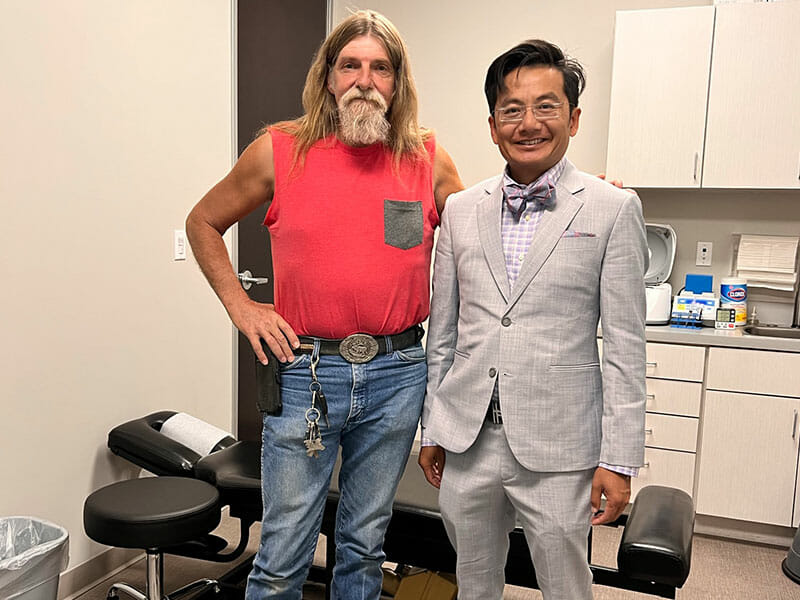
30-Year-Old Injury, Metal Rods in the Spine, 100% Pain Resolution
This patient was struck by a vehicle as a pedestrian 30 years ago. The impact caused spinal fractures that required metal rods and lumbar fusion surgery.
He came to our clinic limping and could not sit down during the examination because the pain was too severe. He had already failed prior steroid epidural injections. His surgeon told him a repeat surgery would not help.
After two PRF with Albumin Gel injections, his back pain resolved completely — 100%. He was able to perform a deep knee bend, a full squat, and jump without any pain.
This case shows that platelet therapy can resolve pain from injuries more than three decades old, and can work even in a spine that has undergone surgical fusion with metal implants.

Garbage Disposal Work Accident, Nerve Damage, Complete Resolution After One Injection
This patient had a workplace accident one year prior to his index finger being caught in a garbage disposal. He had severe pain at the fingertip and flinched at the lightest touch, indicating nerve damage or neuropathy. He could not grip objects normally because even light contact caused sharp pain.
Nerve pain is one of the most difficult conditions to treat in medicine. Standard options, such as medications like gabapentin, rarely produce meaningful relief.
One PRF injection into the tip of his index finger completely resolved his nerve pain. Full touch sensitivity returned to normal. No pain with light or heavy pressure.
This case suggests that platelet therapy may open new possibilities for treating nerve damage a condition where conventional medicine currently has very limited options.
Is PRF Therapy Right for You?
You are likely a good candidate if:
You may NOT be a good candidate if:
Not sure? Call us. Dr. Nguyen evaluates every patient individually before recommending treatment.
If you have had pain for more than three months and nothing has fully worked, call or text (602) 632-0000, and we will tell you honestly whether we think PRF therapy is a good fit for your situation.
PRF Therapy FAQs
Your Questions Answered
If You’ve Had Pain for More Than Three Months, We May Be Able to Help
Dr. Nguyen offers evaluations at our Mesa and Phoenix clinics.
If your pain resulted from a car accident or workplace injury, treatment is likely $0 out of pocket through the medical lien model.
Mesa Clinic (walk-ins welcome): 1155 S Country Club Dr., Mesa, AZ 85210
Phoenix Clinic (by appointment): 4338 W Thomas Rd, #117, Phoenix, AZ 85031
What Patients Say About The Accident Doctors in Phoenix & Mesa
Contact Us Today
Give us a text or call:
(602) 632-0000
Business Hours
Mon – Fri: 9:00 am – 5:00 pm
Sat – Sun: Appointment Only
Let’s Get Social


Mesa Clinic
1155 S Country Club Dr.
Mesa, AZ 85210
(Northeast corner of Country Club and Southern)
Phoenix Clinic
4338 W Thomas Rd, #117
Phoenix, AZ 85031
(Northwest corner of Thomas and 43rd Avenue – inside the Family Practice office)