
Whiplash Treatment in Phoenix & Mesa
You felt fine right after the crash, but now your neck is stiff, your head is pounding, and something is off. That is whiplash. And it almost always gets worse before it gets better if you do not treat it.

Why Whiplash Is So Often Missed in the First 48 Hours
The most dangerous thing about whiplash is how normal you can feel immediately after the accident.
Your body releases adrenaline and cortisol at the moment of impact. These stress hormones suppress pain and inflammation, allowing you to function in an emergency.
In the minutes and hours after a crash, they do exactly what they are designed to do. They mask the injury.
As those hormones clear over the next 24 to 72 hours, the real picture emerges. The rapid back-and-forth snapping of the neck during impact has strained the muscles, ligaments, and facet joints of the cervical spine. Inflammation builds.
Nerves begin to fire. What felt like mild stiffness on the night of the crash becomes serious neck pain, headaches, shoulder pain, and arm tingling by day two or three.
This is not unusual. It is biology. But it creates a real problem: patients who wait to see a doctor create a gap in their medical record that insurance companies use as evidence the injuries were not serious.
If you were in a crash, get evaluated within 24 to 48 hours even if you feel okay.
Call or text (602) 632-0000.
What Whiplash Actually Does to Your Neck
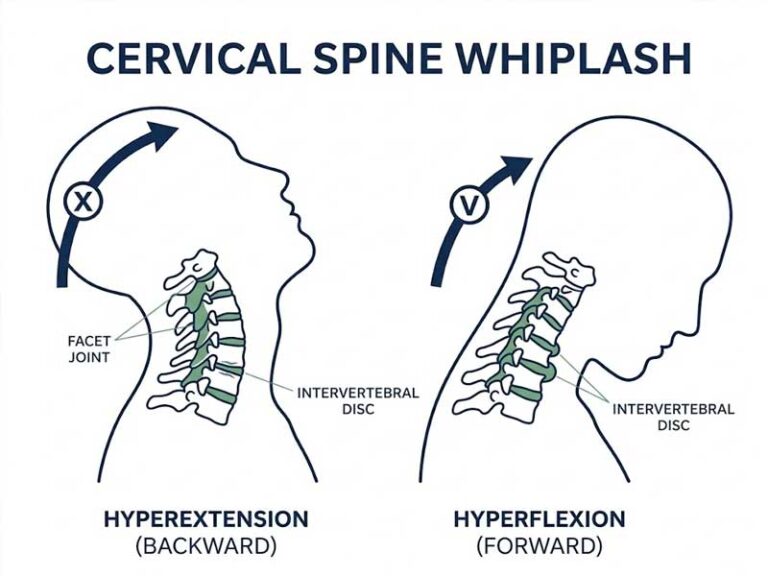
Whiplash is not just a sore neck. It is a specific injury pattern caused by the sudden, forced hyperextension and flexion of the cervical spine during a collision.
In the fraction of a second the impact occurs, the head whips backward and then forward faster than the muscles can react to protect the structures underneath. The result is a combination of injuries that can include any of the following:
Strained or torn cervical muscles and ligaments, facet joint injury at the pivot points of the neck, disc herniation or bulging from the sudden compression, nerve root irritation from swollen soft tissue pressing against the spinal canal, and in some cases concussion or traumatic brain injury from the force transmitted to the skull.
The severity does not always correlate with the speed of impact. Studies have documented significant whiplash injuries from collisions at speeds as low as 6 to 8 miles per hour.
A car that looks undamaged after a crash does not mean the occupant is undamaged.
Whiplash Symptoms
Immediate and Delayed
Symptoms That Appear Within Hours
Neck pain and stiffness: Pain, heaviness, or difficulty turning the head immediately after impact. Often the first and most obvious sign of whiplash injury.
Headache starting at the base of the skull: A headache that begins at the back of the head and radiates forward is a classic cervicogenic symptom from neck trauma. A headache that worsens rather than improves over the first 24 hours is a red flag.
Shoulder and upper back pain: The same forces that injure the neck frequently extend into the upper trapezius and shoulder girdle. Pain and stiffness in the shoulders often accompanies neck injury.
Dizziness and nausea: Feeling unsteady or lightheaded after a crash can indicate concussion, vestibular system disturbance from whiplash, or in rare cases more serious injury.
Numbness or tingling in the arms or hands: Pins-and-needles sensations immediately after impact suggest nerve involvement. This can indicate disc herniation or nerve compression and should be evaluated the same day.
Whiplash Symptoms That Appear 24 to 72 Hours Later
Worsening neck stiffness and reduced range of motion
As adrenaline clears and inflammation peaks, neck stiffness often worsens significantly in the first two to three days. Range of motion becomes increasingly limited.
Radiating arm pain
Pain that travels from the neck down into the arm, forearm, or fingers indicates nerve root irritation from swollen soft tissue or herniated disc material pressing on the cervical spine.
Fatigue and cognitive symptoms
Brain fog, difficulty concentrating, memory problems, and persistent fatigue in the days after a crash are recognized post-concussive and whiplash-associated symptoms, not stress or anxiety.
Sleep disruption
Difficulty falling asleep or staying asleep after an accident is a documented symptom of post-concussive syndrome and pain-related sleep interference. Left untreated, it compounds recovery time.
Jaw pain
Temporomandibular joint (TMJ) symptoms, including jaw pain, clicking, and difficulty chewing, can develop after whiplash, as forces transmitted through the skull and jaw during impact can damage the TMJ.
Does Whiplash Show Up on X-Ray or MRI?

This is one of the most common questions we hear from patients who visited urgent care, were told their imaging looked normal, and went home confused about why they are still in serious pain.
Here is the honest answer.
X-rays are useful after a whiplash injury for ruling out fractures and checking spinal alignment. They do not show soft tissue damage.
Muscles, ligaments, and facet joint injuries do not appear on plain X-ray films. A normal X-ray after a car accident does not mean nothing is wrong.
MRI provides more information and can show disc herniation, ligament damage, and spinal cord involvement when present.
But many significant whiplash injuries still produce normal or near-normal MRI results. The soft tissue and neurological damage causing your pain may not be visible on any imaging at all.
Whiplash is primarily a clinical diagnosis. That means Dr. Nguyen diagnoses it through a detailed physical examination, a careful mechanism-of-injury history, and a specific set of hands-on tests, not by waiting for an imaging report to confirm what the examination has already found.
A normal scan does not mean your pain is not real. It means the injury requires a physician who knows how to find it.
How Dr. Nguyen Treats Whiplash
Whiplash treatment at The Accident Doctors follows a logical progression based on where you are in your recovery and how your injury responds to each stage of care.
Stage 1: Immediate Evaluation and Documentation
Your first visit includes a full physician examination by Dr. Nguyen, on-site X-ray imaging, diagnostic ultrasound when indicated, and a detailed injury causation report linking your symptoms to the crash. If MRI is needed, it is coordinated with our imaging partner and integrated into your care plan.
At this stage, Dr. Nguyen can also prescribe medications when appropriate, including muscle relaxants for severe spasm and neuropathic agents for nerve-related pain. Cervical bracing is provided when clinically indicated.
Stage 2: Active Rehabilitation
Physical therapy is integrated into our specialized accident treatment plans at our clinic. Cervical and scapular strengthening, range-of-motion exercises, and targeted manual therapy form the foundation of early whiplash recovery.
Current medical guidelines consistently show that early, active rehabilitation produces better outcomes than prolonged rest or extended collar use.
Our physical therapy team coordinates directly with Dr. Nguyen so your exercise program is built around your specific injury pattern and imaging findings.
Stage 3: Interventional Treatment for Persistent Pain
When pain has not resolved with active rehabilitation, Dr. Nguyen moves to targeted interventional procedures.
Trigger point injections release tight cervical and shoulder girdle muscles that restrict movement and refer pain into the head and arms. These provide meaningful pain reduction and allow patients to participate more fully in rehabilitation.
Near-facet injections target the facet joints at the pivot points of the cervical spine, which are the most common pain generators in both acute and chronic whiplash. Dr. Nguyen uses direct finger pressure to identify the exact source of pain before injecting, rather than relying solely on imaging to choose the injection site.
Stage 4: PRF Therapy for Chronic or Refractory Whiplash
For patients whose whiplash pain has not resolved after months of treatment elsewhere, or who have tried steroid injections and found only temporary relief, PRF therapy with Albumin Gel is the next step.
Dr. Nguyen uses the 3rd generation Platelet-Rich Fibrin with Albumin Gel protocol, refined at our clinic beginning in 2023. Using platelets drawn from your own blood and re-injected at the precise source of pain, this treatment provokes a targeted immune response that drives natural healing rather than temporarily suppressing inflammation.
Since 2023, our clinic has treated over 600 patients using this protocol across multiple injury types. More than 90% have experienced complete pain resolution after one, two, or three injections.
Chronic whiplash that has not responded to chiropractic care, standard physical therapy, or steroid injections is exactly the patient population where this treatment has produced results others said were not possible.
Whiplash and Your Arizona Insurance Claim

Whiplash is the most common injury claimed in Arizona car accident cases and also the most scrutinized by insurance adjusters. Understanding how documentation affects your claim is as important as understanding your treatment.
Insurance companies look for two things in whiplash claims: a short gap between the accident and your first medical visit, and consistent, objective documentation of your symptoms and treatment throughout your recovery.
Patients who wait more than a few days to see a doctor, or who attend treatment inconsistently, consistently receive lower settlements regardless of how serious their injuries are. The biology of delayed-onset whiplash is well understood and medically expected. The paperwork does not explain itself.
At The Accident Doctors, every visit note is written to document mechanism of injury, objective findings, and treatment response in the level of detail that supports your claim. Dr. Nguyen’s records are built from the first visit with your settlement in mind.
Arizona’s personal injury statute of limitations is two years from the date of the accident. Do not let a documentation gap reduce what you recover.
Whiplash Treatment FAQs
Questions Phoenix and Mesa Accident and Work Injury Patients Ask Most
What Patients Say About The Accident Doctors in Phoenix & Mesa
Are You Experiencing These Symptoms
After a Car Accident?
- Neck pain, stiffness, or reduced range of motion.
- Headache, especially at the base of the skull.
- Lower back pain or stiffness Numbness, tingling, or burning in arms, hands, legs, or feet.
- Shoulder pain or arm weakness
- Dizziness or feeling unsteady
- Fatigue or mental fog
- Abdominal pain or discomfort
- Difficulty sleeping or waking from nightmares
- Anxiety about driving or returning to the accident location
- Pain that started days after the crash
You do not need all of these symptoms to come in. One is enough.
Whiplash Gets Worse When You Wait
Dr. Nguyen sees whiplash patients within
24 hours at our Mesa and Phoenix clinics.
No referral needed. No upfront costs.
If your injury resulted from a car accident,
treatment is $0 out-of-pocket through the medical lien model.
Mesa Clinic (walk-ins welcome): 1155 S Country Club Dr., Mesa, AZ 85210
Phoenix Clinic (by appointment): 4338 W Thomas Rd, #117, Phoenix, AZ 85031
Hours: Monday through Friday 9am to 5pm | Saturday and Sunday by appointment
Contact Us Today
Give us a text or call:
(602) 632-0000
Business Hours
Mon – Fri: 9:00 am – 5:00 pm
Sat – Sun: Appointment Only
Let’s Get Social


Mesa Clinic
1155 S Country Club Dr.
Mesa, AZ 85210
(Northeast corner of Country Club and Southern)
Phoenix Clinic
4338 W Thomas Rd, #117
Phoenix, AZ 85031
(Northwest corner of Thomas and 43rd Avenue – inside the Family Practice office)